Thursday, February 10, 2011

January 24th, Tortoise Country


As has been my custom on this trip, I headed out before breakfast to shoot some bird photos. I found some friendly finches once again, and had some great views of a Galapagos Flycatcher.

Small Tree Finch eating an insect


Large Ground Finch


Yellow Warbler feeding


Galapagos Flycatcher

After breakfast, we headed out in our bus back up to the farming area at mid elevation on Isla Santa Cruz. We stopped first at a lava tube, and we were able to pass through about 600m before climbing out the other side. The tube varied in height from about 2 feet (a tight squeeze on our tummies) to over 30 feet and was well lit along the way.

The lights allowed for some opportunistic ferns to grow over 200 meters from the entrance, which amazed all of us. Once we came out of the tube, we were greeted by a couple of giant tortoises near our bus. The farmland in this area is full of dome shaped tortoises, and the farmers allow them to roam freely across the landscape by raising the lowest section of barbed wire so that the tortoises can pass through. Our guide heard a low grunting noise and brought us over to another field where we were lucky enough to see two tortoises mating, which is supposedly a rare sight.

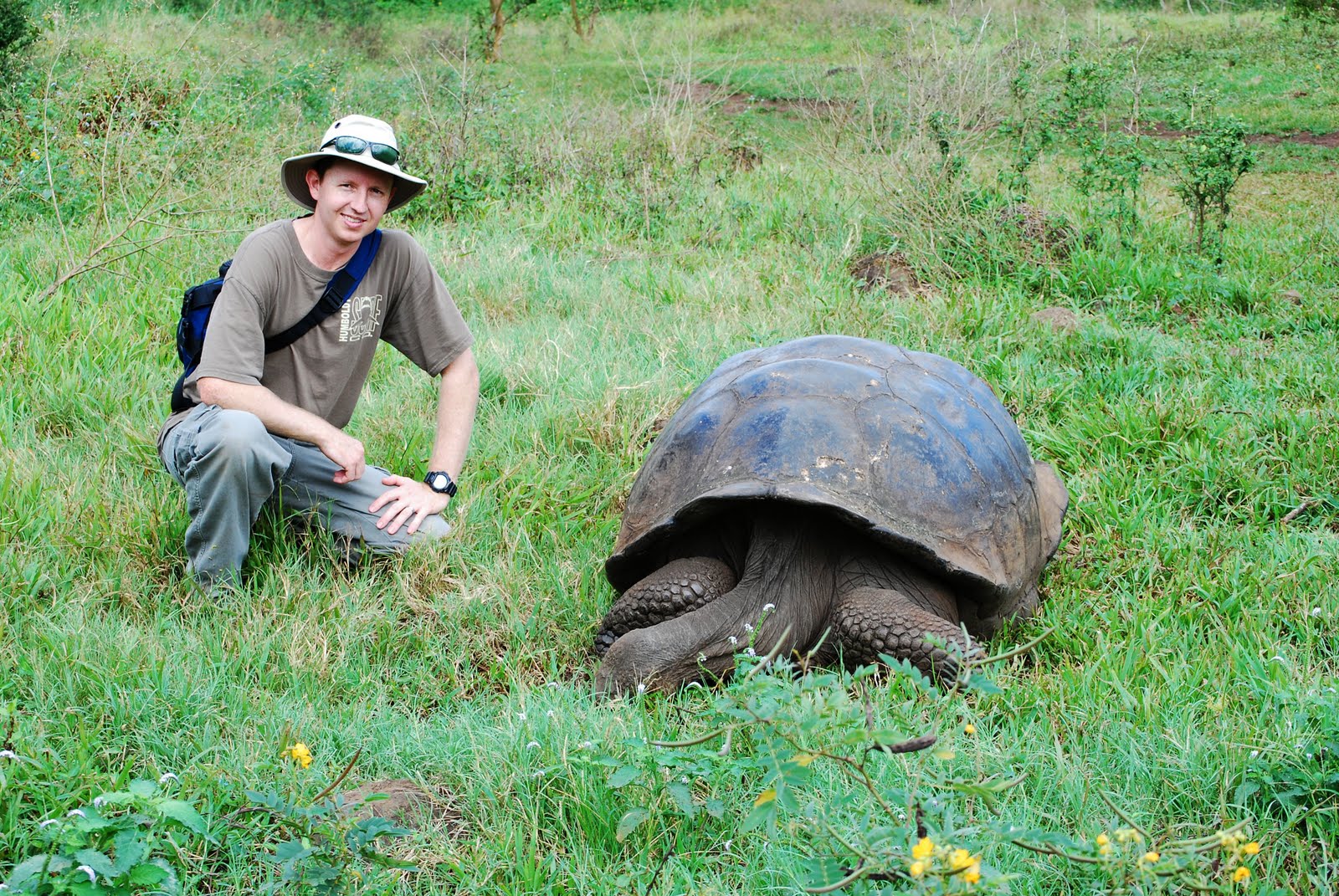
The tour continued at a farm devoted to tortoises and we saw some real giants, some of whom were easily 100 years old and nearly three feet tall.


After lunch, we packed up and hopped on a private boat that would take us to the main hub of our activities for the remainder of the trip on Isabella Island. Hearing that it was going to be an inter island boat ride, I was expecting something along the lines of the catamaran ferry boats that we rode in Greece. As it turned out, the boat wasn't all that much bigger than my dads fishing boat, and the 28 or so passengers was well over the stated capacity of 20 for the boat.

The ocean was pretty rough, throwing our little boat around and splashing the people in the back. After a backbreaking two and a half hours, we finally pulled into port, right as Micky was about to pass out and leave his lunch on board. Luckily, his green pallor revived itself when we neared the shore of Isabella island and pulled into calmer waters. The town of Puerto Villamil is much smaller and more mellow than Porto Ayora, and we arrived at our stunning beach front hotel in a few minutes. Once again, we are very spoiled on this trip and we all agree that between this and Yachana, these are the nicest accommodations of any field bio trip. Definitely not roughing it by any means. We checked into the hotel and cruised over to check out the town. After walking two blocks, we had seen most of it, so we headed out to the pier, where a nice marine iguana was sunbathing and we watched a frigate bird harass a lava gull for his dinner.

Magnificent Frigatebird juvenile
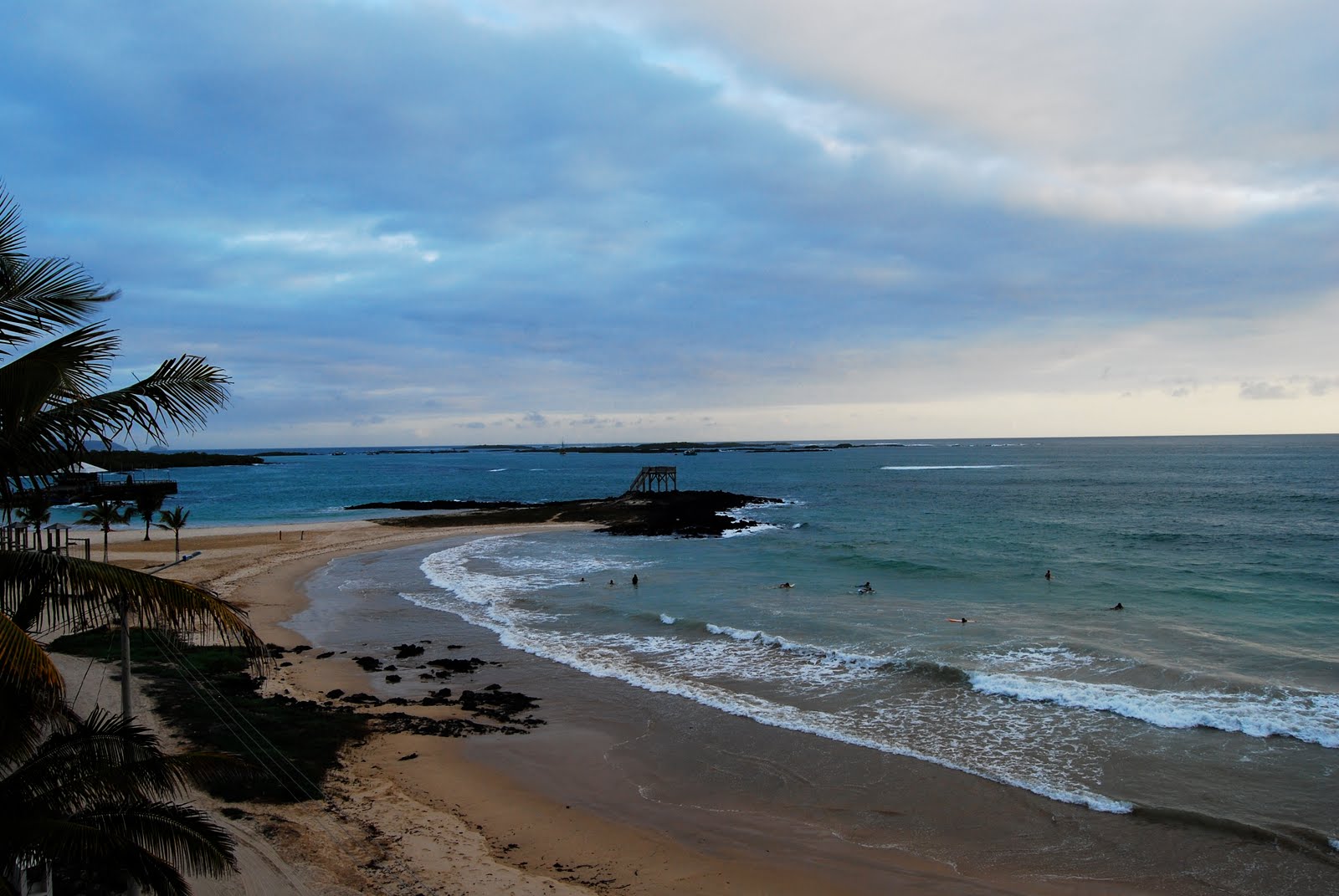

The beaches here are very nice and full of local kids and surfers. But things are definitely not crowded, as there are less than 3000 people living on the island, the majority of which are on the farms at higher elevation.

Not a bad base camp for the next few days! Did I mention, these are views from the hotel!

January 22nd and 23rd. Travel days – Amazonia to Galapagos

Lava Lizard Male, Isla Santa Cruz, Galapagos

After an early breakfast at Yachana, we all loaded up onto the shuttle canoe and met our bus back up river. With a combined sense of sadness to be leaving, and excitement for the next stage of the trip, we drove out of the Amazon towards Quito. After a short stop to stretch our legs and sample the thin air at 13,200 feet, we descended back into the city.

El Paramo high grassland ecosystem, elevation 13,200 feet

Daniel was kind enough to meet us at our hotel and coordinate a laundry run for all of our muddy and mildewy clothes. After settling in, we headed out to dinner, where students had the opportunity to sample one of the local delicacies. Called Cui, the food was prepared in a pretty tame fashion, with only one little foot giving away it’s identity as a guinea pig. I have heard that it is sometimes served whole, where you get to see the toothy face looking back from its plate. I passed this one up, but reviews were overall pretty positive. I was happy enough with my empanada sampler and fresh hot chocolate.

We took an early morning flight from Quito and after a bit of confusion at the airport, and a two hour flight, we arrived in the Galapagos. We landed on the island of Baltra, where the airfield was built by the US air force during World War two. As we waited to get our bags, we were greeted by some lava lizards and two different finch species, which are a little tricky to tell apart, unless you are measuring their beaks.

Small Ground Finch female

The first thing that struck me was how tame the wildlife is on the islands. Humans have only been living in the Galapogos for about a hundred years, so the wildlife doesn't have a historical reason to fear us. Looks like my 200 mm lens will be plenty of zoom for these guys. After getting our bags and meeting our two guides, Julio and William, we caught a bus, hopped on a short ferry to Isla Santa Cruz, and hopped on another bus to the top of the island. Along the way, we passed through dramatically different ecological zones, from the coastal and arid zones to the transitional zone, to the humid upland scalesia zone, which receives much more rainfall and is dominated by Scalesia trees. The Scalesia trees were odd in appearance, owing to their relation to sunflowers.

At the top of the island, we saw two large volcanic craters, which could have been right out of Hawaii's volcanoes national park. The parallels with Hawaii are kind of interesting, as both are volcanic island chains, but the flora and fauna are very different. We drove back down through some farm land on the other side of the island, where we saw our first giant tortoises. We should get a much better view tomorrow, when we hike in the area. As it was, the guides seemed in a hurry to get us to our hotel in Puerto Ayora and get us geared up with our masks and snorkels. After checking in, we had a nice lunch, then, headed out to try our gear. From the main dock, we hopped in a boat taxi, then hiked across a lava field for about 30 minutes to a giant crack in the rocks that was full of sea water.

The objective was for all of us to try on our gear and for the less experienced snorkelers to practice their skills before heading out to the open ocean. It turned out to be a little tricky, as it was Sunday and full of locals dive-bombing from above. We did get to see some neat wildlife, however, including some marine iguanas, Lava Gulls, more finches, and an endemic mockingbird.

Marine Iguana hangout

Lava Gull

Yellow Warbler

Back at the hotel, the students took their second exam with Jay, and Dr. B schooled Zach, Rachel, and I at 8-ball on the hotel pool table. After dinner we walked down to town to check out the scene. The dock area and main part of town were packed with locals of all ages, who come out to socialize. Jeff and I watched as a brown pelican dove for fish in the lights, and a young sea lion seemed to be entertaining himself with some fancy figure eights under the pier.

Pier at Puerto Ayora

Blood Donor

Tuesday, February 8, 2011

January 21st, School day at Yachana

Resident Tree Frog

Today was mostly devoted to the students at Yachana high school. After breakfast, we gathered some of our better Spanish speaking students and hiked the muddy trail back to the school. They were just finishing up an English lesson when we joined the group. There were 23 seniors in the class, all but 5 or 6 of whom were guys. Students at the school came from surrounding communities of different ethnic groups and seemed excited to be at one of the only schools of any quality in the area. Parents pay 200 dollars for their kids to attend, which is about half the average yearly income for most families in the area. Those that show promise, but who can't afford the fee are eligible for a full ride scholarship. The general atmosphere was of an eagerness to learn and we were greeted with enthusiasm by the students. We split the group into three workshop groups. Jeff talked to students about the idea of classification, and students discussed the animals they were familiar with in the forest and how they were related taxonomically. Jay had an interesting discussion about ecological footprints, the impacts of the American way of life on the planet, and the importance of conserving traditional cultures. Students seemed to really identify with the topics brought up in this session. For my group, I wanted to give them some practical guiding tips, as many of the students expressed an interest in becoming guides. We talked about important field marks for birds and how to explain the marks in English. I also encouraged them to learn as much as they could about the different species, such as behavior, foraging strategies, nesting, as well as interesting cultural connections with the birds. Finally, I encouraged the students to make things fun by imitating bird calls through whistles or other means, which can also be effective at bringing birds closer in to the group. Students worked in small groups to present a bird of their choosing, using as much English as possible.

Monique and Paula with students

From the exercise, I learned a few cool cultural things. According to some cultures, the White-throated Toucan is a bringer of rain. It makes a repeated whistling sound, which can be translated as hace sol sol sol. The toucan is complaining about the heat and calling for rain; after two days of calling, the rain will come. Interestingly enough, we heard the bird calling at the Yachana preserve the day before, and last night it rained for the first time since we have been here!
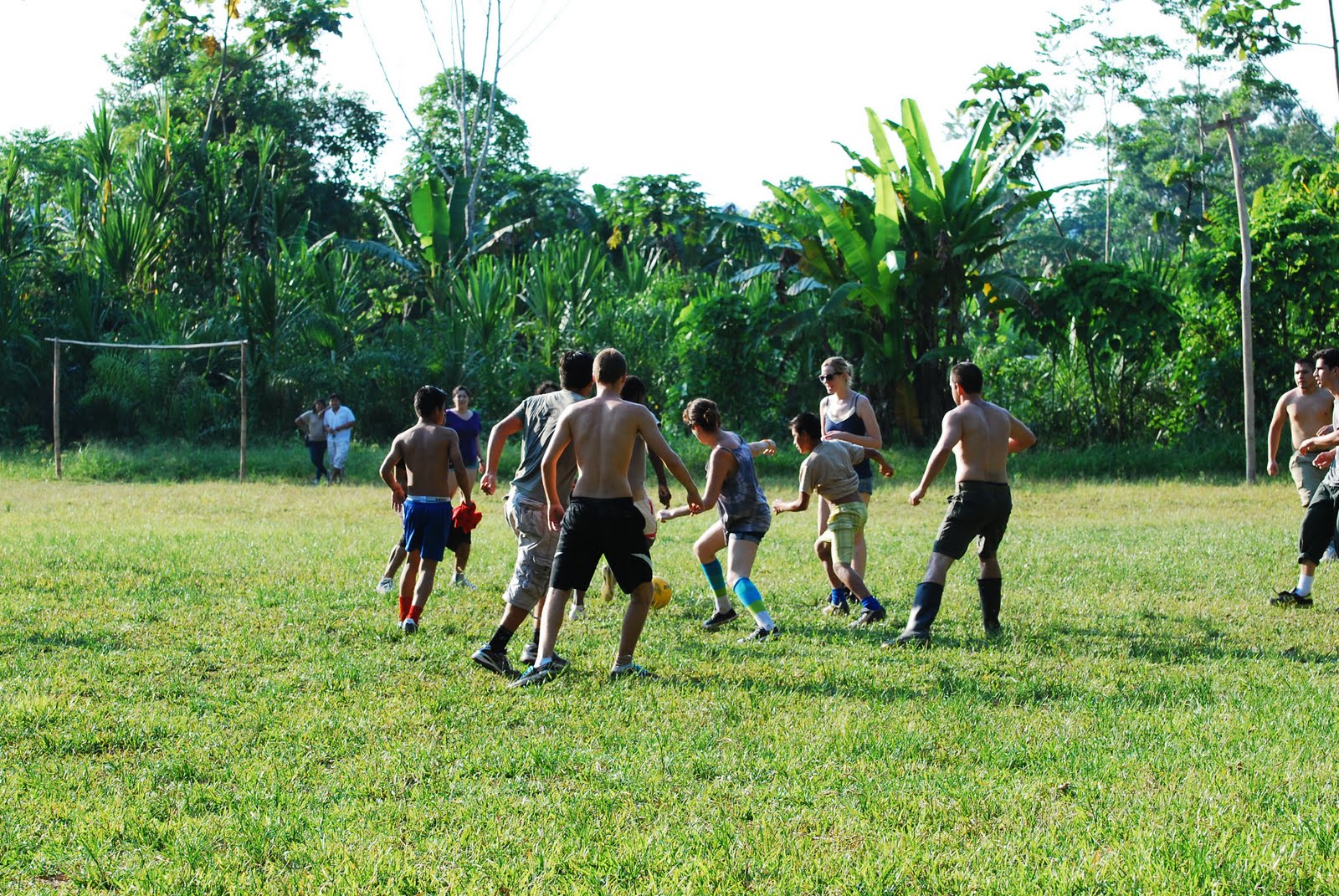
After a quick break for lunch and a siesta, we all headed back to the school for some friendly games with the students. I got caught up along the way photographing some Yellow-rumped Caciques in their colony and when I got to the school, the students were all playing a soccer match. Having played in high school, I jumped at the chance to play again and had a blast, although I am a little afraid of how sore my legs will be in the morning.

After the match, I stopped by a swimming spot at the river to cool off. As this was our final day here, it gave me a chance to soak it all in and reflect on what an amazing experience this trip has been so far. The sun began to set up the river and the view from the water, with reflections of oranges and purples across a pair of dugout canoes, was breathtaking.

After dinner, we headed out into the forest for another mind blowing night hike. With the rain last night, the diversity of herps and inverts was even more incredible than our previous night hike. Highlights for me included a bird-eating tarantula bigger than my hand, a mantis, whose body was flattened out to look exactly like a leaf, and a horned hemipteran with yellow wings.

Bird-eating Tarantula


Mantis


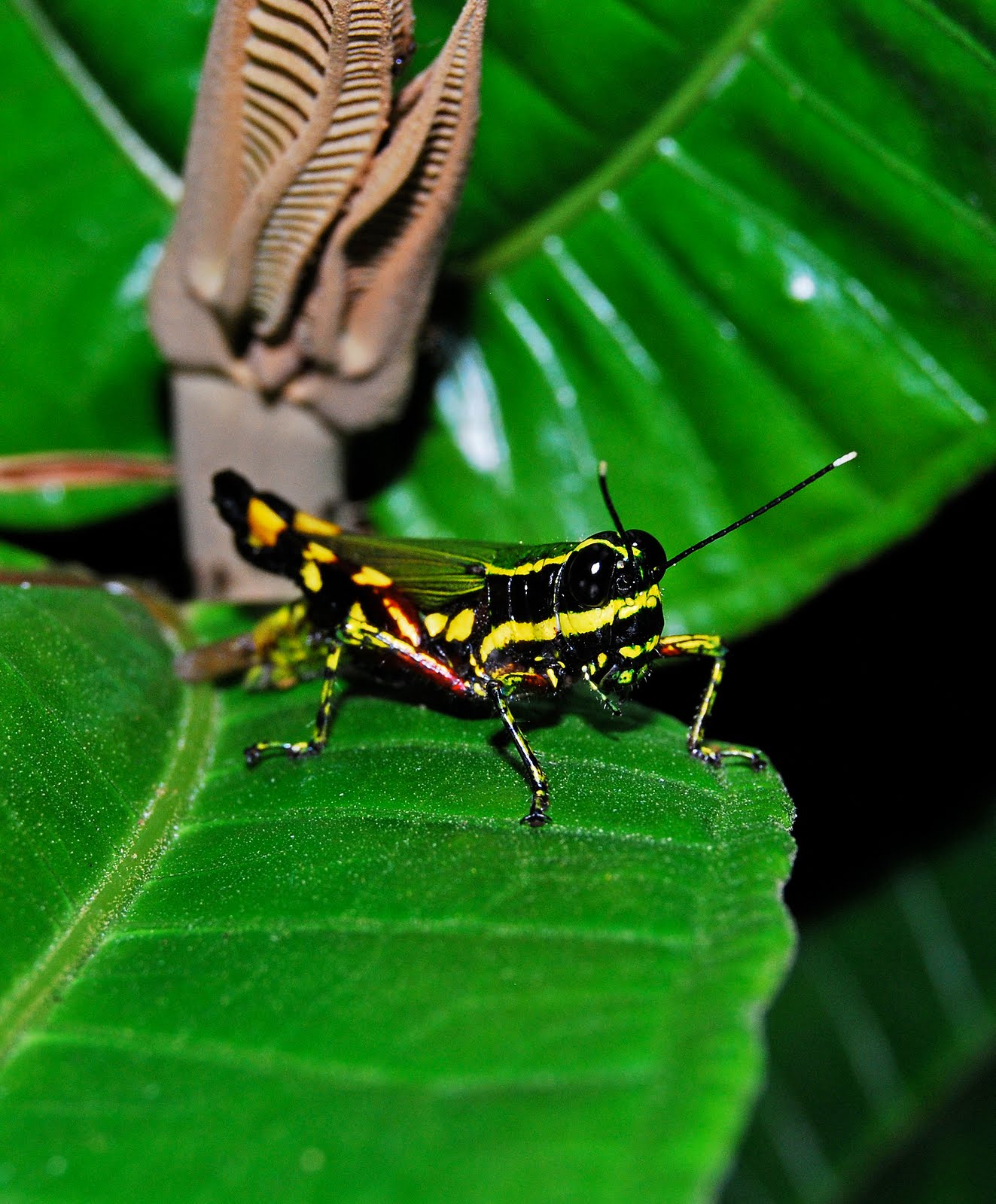
Hemipteran


Tailless Whip Scorpion

Orb Weaver

Walking Stick herbivory


We also saw a beautiful poison dart frog.


Night Lizard

Monday, February 7, 2011

January 20th, Yachana Preserve

Morning Blue

After an early morning breakfast, we headed to a landing site down river and boarded a double-decker bus/truck. We all crammed into the upper level to get a better view of the terrain and drove out to the Yachana preserve, a 500 acre parcel of primary forest owned by the Yachana foundation. Along the way, we had our best birding of the trip with upwards of twenty bird species, including Blue-headed Parrots, Silver-beaked Tanagers and two species of Aracari, which are related to toucans.

Chestnut-eared Aracari

Yellow-rumped Cacique

We also were lucky to run across a band of Black-mantled Tamarins, who squawked their displeasure at our arrival. Eventually, they stopped caring that we were there and even jumped across the trees directly above the truck.

Black-mantled Tamarin

Once we got to the preserve, we hiked a nice hour long loop where we were able to observe a primary forest. The temperature was noticeably cooler in the forest, and it was interesting to compare this forest with the cloud forests and secondary forests that we have observed earlier in the trip. Robert showed us some of the more interesting plants, including one that can be used as an anti venom in case of a viper bite and one that can actually walk, (no kidding!).

The Ironwood palm puts out prop roots, and if it detects an opening in the forest canopy, the tree leans, the prop roots grow in the direction it wants to move, and the tree shifts position. On the way out of the preserve, we also visited a field station that is run by Yachana and Global Vision International (GVI), where volunteers are working on the initial steps of inventorying life in the preserve. One of the more interesting recent finds was a Yellow-footed Tortoise.

We hopped back in the boat and headed to lunch where we were taught some of the traditional cooking techniques and given the chance to try some traditional grub, which happened to include grub!

Zach and Nathaniel prepare tilapia

Rachel serves the appetizer

I couldn't pass up the opportunity, so I joined Max and Rachel in eating a live grub, which was about the size of a large date, and which was supposed to taste like bacon. I will spare you the details, but let's just say that the cooked version was less juicy and I am happy to have had the experience so that I won’t ever feel the need to eat one again. The rest of the cooking demo included stinging nettles, which tasted like delicious spinach, heart of palm, which was also good in raw form, and roasted tilapia, cooked in a banana leaf over a smoky fire. Our post lunch activity included a float down the river. We packed a cooler full of beer, inverted some life vests to fit like a large diaper, and floated down the river with a cold one in hand. It was truly a surreal and memorable experience to be in the river and floating through the Amazon jungle. After a nice dinner, which included another chat with the founder of Yachana, Douglas, we headed out on a night hike around the lodge.

Trapdoor spider's lair

What a cool activity! The forest truly comes alive at night. We saw many frogs of different types, walking sticks, tarantula spiders, and even a euphonia female on a nest made of moss.

Another beautiful day in paradise!